
BMW Repair & Maintenance | Rocky Mount, NC
BMW Oil Leak: 9 Common Causes, Warning Signs & Repair Options
A BMW oil leak may start as a small amount of residue around a gasket or develop into a significant engine lubrication problem. Understanding the symptoms, possible sources and urgency can help you avoid unnecessary repairs and protect your vehicle.
Have you noticed oil stains where you park, a burning oil smell after driving, or an engine oil warning on your dashboard? These symptoms deserve attention, but they do not automatically identify the failed part.
BMW oil leaks can originate from engine gaskets, housings, oil connections and crankshaft seals. The cause and repair complexity depend on your BMW's engine family, model year, mileage, maintenance history and operating conditions.
A BMW 3 Series equipped with one engine design may have different sealing arrangements than an X5 or 5 Series with another engine. This is why accurate diagnosis matters more than replacing parts based on a symptom alone.
This comprehensive guide covers nine potential BMW oil leak causes, common warning signs, safe next steps, repair considerations, cost factors and the difference between minor seepage and active leakage.
Quick Answer: Why Is My BMW Leaking Oil?
A BMW oil leak occurs when engine oil escapes through a gasket, seal, housing, connection or another part of the lubrication system. Potential sources include the valve cover gasket, oil filter housing gasket, oil pan seal, timing cover, turbocharger oil lines and rear main crankshaft seal.
Common warning signs include fresh oil under the vehicle, oily engine surfaces, burning oil odors and repeated low-oil-level messages. However, light residual oil does not always mean an active leak requiring replacement parts.
Important: A red oil-pressure warning, rapid oil loss, heavy smoke or a suspected engine-compartment fire requires immediate safety precautions. Stop safely, shut down the engine and seek professional assistance rather than continuing to drive.
Is a Small BMW Oil Leak Always Serious?
No. A small amount of oil residue is not necessarily a serious active leak. BMW's Service Information Bulletin SI B01 10 21 distinguishes light engine oil accumulation or sweating from more substantial oil leakage, pooling, dripping and spotting.
Light accumulation may not require immediate repair in some circumstances. A technician must establish whether the area contains old residue, oil from recent maintenance or fresh oil escaping from a sealing surface.
Minor Oil Seepage
A thin oily film without active dripping or measurable oil loss may warrant cleaning and monitoring.
Active Oil Leakage
Fresh wet oil, recurring drips or growing stains suggest a leak that should be diagnosed.
Urgent Oil Loss
Rapid oil loss, a red pressure warning or oil reaching hazardous areas may require stopping the vehicle immediately.
This distinction prevents two costly mistakes: replacing components that are not leaking and ignoring an active leak that could threaten engine lubrication or safety.
Manufacturer reference: BMW External Engine Oil Leaks and Repairs — SI B01 10 21.
BMW Oil Leak Infographic: Causes, Warning Signs & Repair Options
The infographic below summarizes nine possible oil leak sources, common symptoms and repair approaches. It provides an educational overview, not a confirmed diagnosis for an individual vehicle.
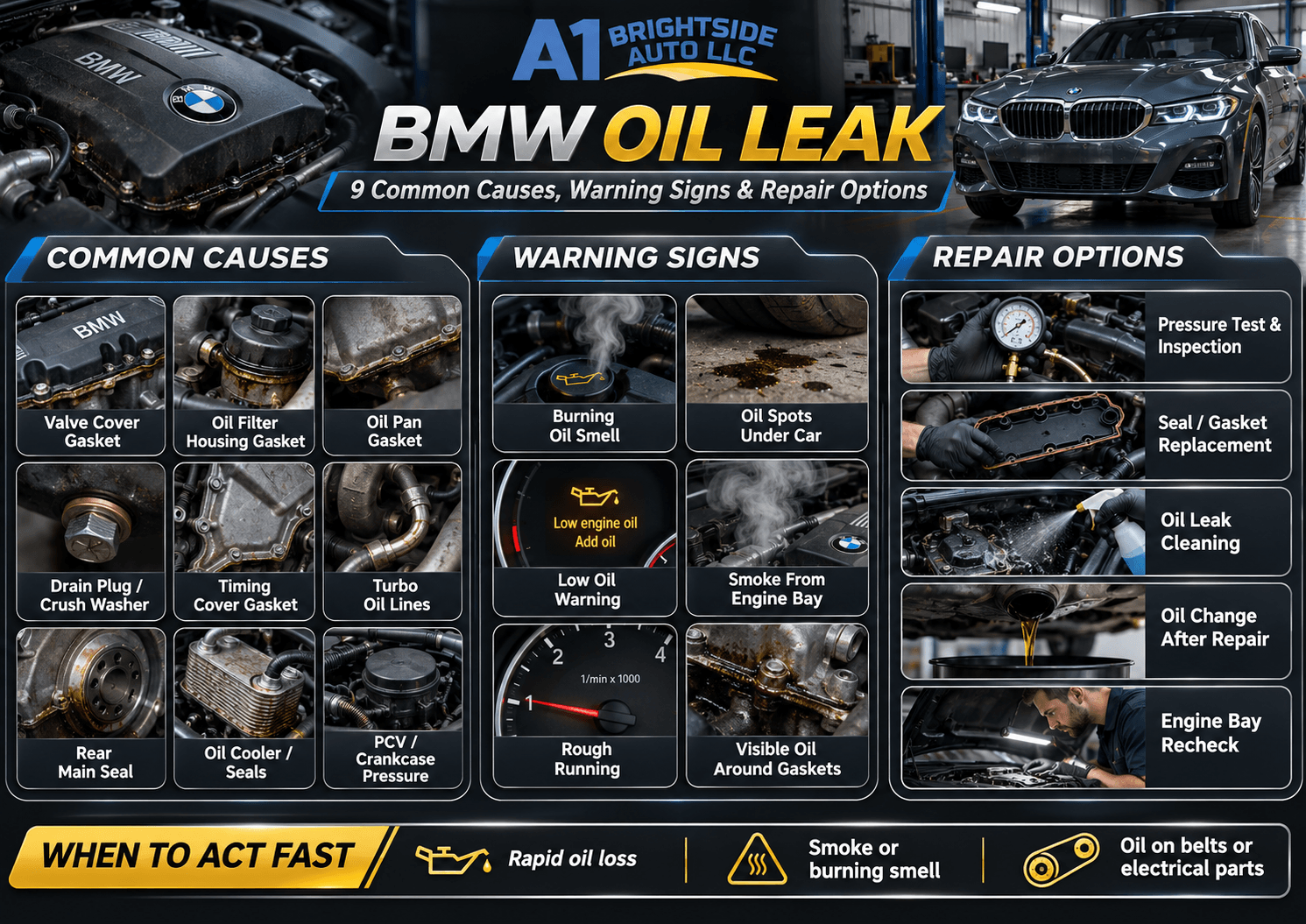
For a reliable diagnosis, a repair technician must locate the actual point where fresh oil escapes rather than assuming the component shown nearest to an oil stain is responsible.
9 Common Causes of BMW Oil Leaks
The nine problems below are recognized potential sources or contributing causes. They are not a verified statistical ranking across all BMW vehicles. Engine design and service history determine which should be inspected first.
Valve Cover Gasket Leaks
The valve cover, also known as the cylinder head cover, seals the upper engine. The gasket helps prevent oil from escaping while lubricated valvetrain components operate beneath it.
Repeated heat cycles, aging gasket material and certain engine-specific sealing issues can contribute to leaks. Oil escaping from the upper engine may travel along the cylinder head or down the engine block.
If that oil reaches hot exhaust components, the driver may notice a burning oil smell, particularly after the engine warms up. Some leaks produce visible smoke or oily residue without leaving a puddle under the vehicle.
Repair approach: Confirm the active source, inspect the valve cover and sealing surface, and replace or repair the affected components according to engine-specific procedures.
BMW's SI B11 03 15 bulletin identifies cylinder head cover leakage associated with retaining bolts in certain N20 and N26 applications. This bulletin does not apply to every BMW.
Oil Filter Housing Gasket Leaks
The oil filter housing contains or supports components associated with filtering engine oil. Depending on the BMW engine, gaskets or seals connect the housing to surrounding components.
When these seals deteriorate or a housing interface fails, oil may accumulate around the housing and travel down the engine. Some arrangements also include connections to an engine oil cooler.
Oil moving along exterior engine surfaces can make the apparent leak location misleading. An oil spot beneath the vehicle may be several inches or more away from its original source.
Repair approach: Check the exact housing design, confirm the leaking interface and inspect related components before selecting the appropriate sealing repair.
Oil contamination of nearby drive-belt components is an additional concern on applicable engine layouts and deserves prompt evaluation.
Oil Pan Gasket or Seal Leaks
The oil pan forms the lower section of the engine's oil containment system. Depending on design, the pan may use a replaceable gasket or another specified sealing method.
A damaged sealing surface, deteriorated gasket or other sealing problem can allow oil to collect around the pan. Because this part sits low on the engine, a leak may eventually create drips or stains beneath the vehicle.
However, an upper-engine leak can run down onto the pan. A wet oil pan does not automatically prove that its own gasket is defective.
Repair approach: Rule out upper-engine leakage, verify the sealing failure and determine the necessary repair for the specific oil pan design.
Some oil pan repairs involve significant disassembly. Confirmation is especially important before authorizing the work.
Oil Drain Plug or Sealing Washer Problems
A leak that appears soon after an oil change may involve the oil drain plug, its sealing washer or the oil filter assembly. Different BMW applications use different sealing arrangements.
A damaged washer, improper installation, unsuitable replacement component or compromised thread can allow oil to escape.
Residual oil from a recent service is another possibility. Oil spilled onto an underbody shield may drip later even though there is no ongoing mechanical leak.
Repair approach: Verify the correct parts, sealing surfaces and installation procedure. Do not simply overtighten the drain plug.
When leakage begins immediately after maintenance, contacting the servicing shop is a sensible first step.
Timing Cover Gasket or Seal Leaks
The timing cover encloses components associated with engine timing. Depending on the engine family, the cover is sealed using gaskets, sealant or other specified components.
Oil can escape along cover joints or around related seals. Because the timing cover sits near other oil-containing components, a leak may resemble a problem with the oil filter housing or oil pan.
Timing cover repairs may be labor-intensive, particularly if access requires removing other engine components.
Repair approach: Trace the highest active leak point and use engine-specific service procedures before undertaking substantial disassembly.
Replacing an expensive sealing component without first proving it is the source can leave the original problem unresolved.
Turbocharger Oil Line Leaks
Turbocharged BMW engines use pressurized oil to lubricate turbocharger components. Oil supply and return connections must remain properly sealed.
Leaks can develop at the relevant connections or sealing interfaces. Oil escaping around the turbocharger may reach nearby hot components, making burning odors or smoke particularly concerning.
Blue exhaust smoke and excessive oil consumption can also result from internal engine or turbocharger problems. Neither symptom alone proves an external oil-line leak.
Repair approach: Confirm whether leakage is external or related to oil consumption, then inspect and repair the affected connection.
Turbocharger areas can remain extremely hot after driving. Avoid touching these components during a personal inspection.
Rear Main Crankshaft Seal Leaks
The rear main seal helps keep engine oil inside the engine where the crankshaft exits near the transmission.
When the seal leaks, oil may appear around the joint between the engine and transmission. However, oil traveling downward from another component can create a similar appearance.
Rear main seal repairs may require extensive access to drivetrain components, so careful diagnosis is necessary.
Repair approach: Exclude leaks originating higher on the engine and assess possible crankcase pressure problems before recommending seal replacement.
Oil around the engine-to-transmission junction should not automatically result in an expensive rear main seal repair recommendation.
Oil Cooler or Heat Exchanger Seal Leaks
Some BMW engines have oil coolers or heat exchangers designed to manage lubricant temperature. Connections and sealing surfaces around these assemblies can become leak points.
External leakage may produce oily residue near the cooler, adjacent housing or connecting lines.
Internal failures involving oil and coolant systems are different from simple external oil leakage and require separate diagnostic procedures.
Repair approach: Identify the precise cooler or heat exchanger configuration, inspect relevant seals and confirm the failed interface.
Because BMW engine layouts vary considerably, a photograph from a different engine may not accurately identify the components on your vehicle.
PCV or Crankcase Ventilation Problems
The positive crankcase ventilation system helps regulate gases and pressure inside the engine crankcase.
When ventilation components malfunction, abnormal crankcase pressure may contribute to oil leakage through already weakened gaskets or seals.
Some BMW engines integrate crankcase ventilation components into the valve cover, while other engine designs use different configurations.
A PCV malfunction is not necessarily the physical location where the oil escapes. Instead, it may be a contributing condition that worsens another sealing problem.
Repair approach: Evaluate crankcase ventilation performance along with the visible oil leak. Repairing only the gasket may not resolve an underlying pressure problem.
BMW Oil Leak Symptoms: What Are the Warning Signs?
The symptoms below can indicate an engine oil problem, but none should be used alone to identify a failed gasket or determine the exact repair.
| Warning Sign | Possible Explanation | Recommended Action |
|---|---|---|
| Oil spots under the BMW | Possible external leakage from a gasket, seal or connection | Arrange an inspection and monitor the oil level safely |
| Burning oil smell | Oil contacting hot engine or exhaust surfaces | Seek prompt evaluation; stop if smoke or fire risk develops |
| Low oil level message | Oil loss, consumption or another issue needing confirmation | Follow the exact dashboard and owner's manual instructions |
| Red oil-pressure warning | Potentially inadequate engine lubrication | Stop safely, shut off the engine and arrange towing |
| Smoke from the engine compartment | Oil contacting hot parts or another mechanical or electrical fault | Stop safely and obtain appropriate assistance |
| Oil on belts or pulleys | Possible contamination of drive components | Arrange prompt professional inspection |
| Visible oil around gaskets | Old residue, minor seepage or active leakage | Confirm source and severity |
| Rough running or unusual noise | Numerous possible engine faults | Diagnose independently rather than assuming an oil leak |
Oil Pressure vs. Oil Level: An Important Difference
Low engine oil level and low engine oil pressure are not the same condition. A level message concerns the quantity of oil, while a pressure warning may indicate inadequate lubrication.
A red oil-pressure warning demands an immediate safe stop and engine shutdown. Adding oil does not necessarily resolve the underlying problem. Follow your BMW's specific instructions.
Why Is My BMW Leaking Oil But There Is No Puddle?
A BMW can lose oil without leaving an obvious puddle where it is parked.
Oil may collect inside an underbody panel, remain on engine components, or escape only when the engine is running and hot. A small amount can also contact a hot surface and burn away before reaching the ground.
Alternatively, the engine may be consuming oil internally rather than leaking externally. Oil residue left behind during service can also resemble a leak without representing ongoing oil loss.
If the vehicle repeatedly requires oil top-offs or displays warning messages, professional evaluation is appropriate even when your driveway remains dry.
How Can You Tell if a BMW Is Leaking Oil or Burning Oil?
An external engine oil leak occurs when oil escapes through a gasket, seal, housing or another external connection. Burning oil generally refers to oil being consumed in the engine or reaching hot components where it burns.
Both conditions can cause a declining oil level, but the repairs are different.
An external leak may leave wet engine components or fresh stains on the ground. Internal oil consumption may occur without obvious external staining. Blue or blue-gray exhaust smoke can sometimes accompany oil burning, but exhaust color is not a definitive diagnosis.
Some BMWs may experience more than one oil-related issue simultaneously. If oil is disappearing without visible drips, the diagnostic process should consider both external leakage and oil consumption.
Can You Drive a BMW With an Oil Leak?
Whether it is safe to drive depends on the leak's severity, the engine oil level, oil pressure, nearby components and the specific symptoms displayed.
Light old residue without active leakage may require monitoring rather than immediate repair. Fresh dripping, persistent burning odors or repeated low-oil-level warnings justify timely evaluation.
| Situation | General Guidance |
|---|---|
| Minor residue, normal oil level | Arrange assessment if uncertain and monitor appropriately |
| Small active leak | Obtain prompt diagnosis and avoid unnecessary driving until severity is known |
| Persistent burning smell | Seek prompt inspection; stop if smoke or other danger develops |
| Rapid oil loss | Do not continue driving; arrange assistance |
| Red oil-pressure warning | Stop safely, switch off the engine and arrange towing |
| Smoke or suspected fire | Stop, move occupants to safety and contact emergency services if necessary |
Do not assume the engine is safe merely because it continues running normally. Some lubrication problems can cause damage before obvious drivability changes occur.
What Should You Do if Your BMW Starts Leaking Oil?
- Park in a safe location. If you observe a red oil-pressure warning, rapid oil loss or heavy smoke, shut the engine down as soon as it is safe.
- Read the warning message carefully. BMW oil-level and oil-pressure alerts can require different actions. Consult the vehicle-specific owner's manual.
- Observe visible symptoms safely. Note stains, odors and smoke without touching hot or moving engine components.
- Check oil level using the approved method. Many BMW models use an electronic oil-level measurement system with specific operating requirements. Do not overfill.
- Record the circumstances. Note the vehicle's mileage, recent repairs, when the leak occurs and whether oil-level messages have appeared.
- Contact a qualified repair shop. Explain the symptoms and ask whether driving is appropriate. If safe operation is uncertain, arrange towing.
How Does a Mechanic Find the Source of a BMW Oil Leak?
Accurate diagnosis focuses on identifying the point where fresh engine oil first escapes, not merely locating where the oil eventually accumulates.
1. Review the Vehicle's History
The technician considers the model, production year, engine configuration, mileage, past repairs, oil services and current symptoms. This helps identify relevant components and service information.
2. Inspect Common Leak Locations
The engine and underbody are examined for oil around the valve cover, oil filter housing, oil pan, timing cover, turbo connections and other applicable components.
3. Distinguish Old Oil From Active Leakage
Approved cleaning and observation procedures may help establish whether fresh oil reappears. In selected cases, an oil-compatible fluorescent dye and appropriate inspection equipment can assist with tracing difficult leaks.
4. Evaluate Contributing Conditions
Depending on findings, technicians may examine crankcase ventilation performance, nearby belts, oil contamination and other possible leak paths.
5. Complete the Repair and Verify Results
After the confirmed fault is repaired, the affected area should be inspected under appropriate operating conditions to verify that active leakage has stopped.
How Much Does BMW Oil Leak Repair Cost?
BMW oil leak repair costs depend on the actual failed component, engine design, labor accessibility, parts and any related damage.
A drain plug sealing issue may be comparatively straightforward. Replacing an inaccessible rear main seal or resealing a complex timing cover can require significantly more labor.
| Possible Repair | General Complexity | Primary Cost Factors |
|---|---|---|
| Drain plug seal | Often lower | Sealing arrangement and thread condition |
| Valve cover gasket | Moderate to higher | Engine access and cover condition |
| Oil filter housing seal | Moderate to higher | Housing design and surrounding components |
| Oil pan gasket | Moderate to substantial | Drivetrain and undercarriage access |
| Timing cover resealing | Potentially substantial | Required disassembly and engine design |
| Turbo oil line repair | Variable | Connection location and access |
| Rear main seal | Often substantial | Transmission and drivetrain access |
These are general labor-complexity comparisons, not quotes or verified local prices. A dependable estimate requires an inspection and a confirmed diagnosis.
For assistance in Rocky Mount, North Carolina, visit A1 Brightside Auto's BMW repair service page to learn about available BMW services.
Does a BMW Oil Leak Mean You Need a New Engine?
No. An external engine oil leak does not automatically mean an engine needs replacement. Many leaks involve repairable gaskets, seals, housings or connections.
However, severe oil loss can create inadequate lubrication and potentially cause internal engine damage. The consequences depend on how long the engine operated with the problem, the amount of oil lost and whether oil pressure was affected.
When internal damage is suspected, additional testing may be necessary beyond repairing the external leak.
For broader problems involving engine performance or mechanical damage, see engine repair services in Rocky Mount, NC.
Which BMW Models Are More Likely to Develop Oil Leaks?
There is no reliable universal answer without specifying engine family, model year, mileage, maintenance history and the source of the comparison.
For example, BMW issued SI B11 03 15 addressing cylinder head cover leakage associated with certain N20 and N26 engine applications. It includes specified vehicles across the BMW 2 Series, 3 Series, 4 Series, 5 Series, X1, X3 and Z4 lines.
This is evidence of a documented problem on covered applications, not proof that every vehicle in those model lines will experience the same failure.
Other BMW engines have different oil system arrangements and require different inspection procedures. The engine identification and applicable manufacturer service information are more useful than the model badge alone.
Can an Oil Change Fix a BMW Oil Leak?
An oil change generally does not repair a failed gasket or defective seal. Replacing the oil maintains proper lubrication but does not restore damaged sealing surfaces.
When the problem involves a recently installed oil filter, drain plug or sealing washer, correcting the installation or replacing the damaged component may resolve the leakage.
Changing oil viscosity merely to conceal a leak is not an appropriate substitute for diagnosis. Follow the specifications and approvals applicable to your BMW.
If your vehicle needs scheduled maintenance, visit A1 Brightside Auto's oil change services.
How Can BMW Owners Reduce the Risk of Oil Leaks?
Maintenance cannot prevent every gasket or seal failure, but it can improve the chance of identifying a developing problem early.
- Follow the proper service schedule. Use engine oil, filters and installation procedures appropriate for your BMW.
- Pay attention to dashboard messages. Repeated low-oil-level notifications deserve investigation.
- Notice new odors. Burning oil smells can warrant inspection even when no puddle is visible.
- Check for leakage after maintenance. Fresh drips after servicing may require a follow-up inspection.
- Investigate repeated gasket failures. Recurring problems can indicate an unresolved contributing condition.
- Maintain service records. A documented history can help technicians identify patterns and previous repair work.
- Avoid ignoring oil contamination. Oil reaching drive belts, wiring or hot exhaust components can create additional problems.
The goal is not merely to keep the engine exterior clean; it is to preserve lubrication, identify unsafe conditions and correct active leaks before secondary damage develops.
BMW Oil Leak Repair in Rocky Mount, NC
If your BMW has fresh oil stains, a burning oil smell or repeated oil-level warnings, an appropriate diagnostic evaluation can help determine whether you are dealing with light seepage, an active external leak or another engine oil issue.
A1 Brightside Auto LLC serves drivers in Rocky Mount, North Carolina, with BMW repair and automotive maintenance services.
Before contacting the shop, gather your BMW's model, year, mileage and a description of the symptoms. Mention whether the issue began after recent maintenance and whether warning lights or messages appeared.
Address: 1826 Sunset Ave, Rocky Mount, NC 27804
Phone: (252) 231-3301
Hours: Monday–Friday, 8:00 AM–6:00 PM
Concerned About a BMW Oil Leak?
Get information about the next step for your BMW. Contact A1 Brightside Auto to discuss the symptoms and confirm inspection or repair availability for your specific vehicle.
Explore BMW Repair Services Call (252) 231-3301Frequently Asked Questions About BMW Oil Leaks
1. What is the most common cause of a BMW oil leak?
Valve cover gaskets, oil filter housing seals and other engine gaskets are recognized potential BMW oil leak sources, but no single cause can be called the most common across all models and years without reliable comparative data. Engine configuration, age, mileage and maintenance history affect leak patterns. A technician should confirm the actual source before recommending a repair.
2. Why does my BMW smell like burning oil?
A BMW may smell like burning oil when leaking engine oil contacts a hot exhaust or engine component. A valve cover gasket leak is one possible cause, although other external leaks can create the same symptom. If the odor is strong, accompanied by smoke or associated with a suspected fire hazard, stop safely and seek assistance rather than continuing to drive.
3. Is it normal for older BMWs to leak oil?
Aging gaskets and repeated heat cycles can contribute to oil leaks, but active leakage should not automatically be dismissed as normal. BMW distinguishes minor oil accumulation from active dripping or pooling. Some residue may warrant monitoring instead of immediate repair. Repeated oil loss, fresh drips or unsafe contamination should be investigated, regardless of vehicle age.
4. Can I drive my BMW with a small oil leak?
Whether continued driving is appropriate depends on the severity of the leak, oil level, oil pressure, location and associated symptoms. Light old residue may not represent an active problem, while fresh leakage should be evaluated. Never continue driving with a red oil-pressure warning, rapid oil loss or a suspected fire hazard. If uncertain, ask a qualified technician before driving.
5. Why is my BMW leaking oil after an oil change?
Oil appearing after an oil change may be leftover oil from servicing or a leak involving the drain plug, washer, oil filter seal or another component. A preexisting leak may also become noticeable around the same time. The correct next step is to inspect the area, confirm the installed sealing components and distinguish residual oil from an active leak.
6. How can I tell whether my BMW valve cover gasket is leaking?
Possible signs include fresh oil around the valve cover perimeter, staining on the upper engine or a burning oil odor. These signs are not conclusive because oil can migrate from another source or remain after previous maintenance. Diagnosis should establish fresh leakage at the cover sealing interface and determine whether the gasket, cover or another component needs attention.
7. Why is my BMW losing oil without leaving a puddle?
Oil can collect on an underbody panel, cling to engine surfaces or escape only when the engine is operating. Some oil may burn after contacting hot components. The engine may also consume oil internally without external leakage. Repeated oil loss should be investigated, even when the parking surface remains clean, because the absence of puddles does not rule out a problem.
8. How much does BMW oil leak repair cost?
The cost depends on the failed part, model, engine, accessibility and required labor. A simple sealing washer issue may be less involved than a timing cover or rear main seal repair. Additional damage or related component problems can increase complexity. A reliable estimate requires diagnosis of the actual leak source and inspection of the specific BMW.
9. Can a BMW oil leak cause the check engine light to come on?
An external oil leak does not necessarily activate the check engine light, which generally indicates a monitored engine or emissions-system fault. A related issue, such as a crankcase ventilation malfunction, may trigger diagnostic codes or drivability symptoms. The fault codes and oil leakage should be evaluated rather than assuming one automatically explains the other.
10. Can an oil leak damage my BMW engine?
Yes. Severe oil loss can lead to inadequate lubrication, accelerated wear or major engine damage. Oil contacting hot exhaust components may also create smoke or a fire hazard. The risk depends on leak location, severity and resulting oil pressure or level conditions. A red oil-pressure warning requires an immediate safe stop and engine shutdown.
11. Does a BMW oil filter housing leak need immediate repair?
Urgency depends on the amount of active leakage and whether oil is reaching vulnerable components. Minor old residue may only require monitoring after inspection, while fresh dripping, rapid oil loss or belt contamination warrants prompt attention. A technician should confirm the affected sealing interface and apply the relevant BMW repair guidance before recommending replacement.
12. Where can I get a BMW oil leak inspected in Rocky Mount, NC?
A1 Brightside Auto LLC offers BMW repair and maintenance services at 1826 Sunset Ave, Rocky Mount, NC 27804. Contact the shop at (252) 231-3301 to discuss your vehicle's model, year, mileage and symptoms and confirm available service. If the engine has severe leakage or a red oil-pressure warning, arrange safe transportation rather than driving it to the shop.
Final Takeaway: Diagnose Your BMW Oil Leak Before Replacing Parts
BMW oil leaks can arise from relatively accessible seals or from components requiring substantial repair labor. The smartest approach is not to assume every oil stain means a major problem, nor to dismiss repeated dripping as harmless.
Confirm whether the oil is fresh, identify the true leak source, assess dashboard warnings and determine whether the vehicle is safe to operate.
Manufacturer guidance emphasizes distinguishing minor seepage from active leakage. That distinction can help avoid unnecessary repairs while making sure significant problems are addressed promptly.
For BMW repair inquiries in Rocky Mount, visit A1 Brightside Auto LLC's BMW service page.
Sources & Technical References
1. BMW of North America — External Engine Oil Leaks and Repairs, Service Information Bulletin SI B01 10 21 (2021).
Manufacturer guidance explaining minor oil accumulation, active leakage and related repair considerations.
Read the BMW technical bulletin
2. BMW of North America — N20 and N26 Engine: Oil Leaks from Cylinder Head Cover, SI B11 03 15 (2015).
Documents a specific cylinder head cover sealing issue affecting certain BMW applications.
Read the cylinder head cover bulletin
3. A1 Brightside Auto LLC — BMW Repair and Maintenance.
Business and local BMW service information.
Explore BMW repair services
Evidence limitations: The nine potential causes in this guide are not ranked by verified failure frequency. Manufacturer bulletins apply only to the specific vehicles and circumstances described. Proper diagnosis requires vehicle-specific inspection and applicable service information.